
Endodontic Retreatment in Marietta, GA
You did everything right the first time — had the root canal, followed the aftercare instructions, got the crown placed. But now, months or years later, that same tooth is causing pain again. It’s frustrating, but it doesn’t mean the tooth is lost. Endodontic retreatment can often resolve what the first procedure couldn’t and give the tooth a real path to long-term survival.
At West Atlanta Endodontics, Dr. David Norrington and Dr. James Smithson perform endodontic procedures including retreatment at their Marietta, GA practice. Using surgical microscopes and cone beam CT imaging, they identify exactly why the first root canal failed — and address it precisely.
Why Would a Tooth Need Retreatment?
Root canal therapy has a high long-term success rate, but failures do occur. Common reasons a tooth may need retreatment include:
- Missed canals — complex root anatomy sometimes hides accessory or curved canals that weren’t fully cleaned during the original procedure
- Incomplete sealing — if the filling material didn’t reach or seal all the way to the root tip, bacteria can recolonize over time
- Delayed restoration — waiting too long to place a crown after a root canal allows bacteria to re-enter through the temporary filling
- New decay or fracture — a new cavity or crack can reintroduce bacteria into a previously treated tooth
- Reinfection from adjacent tissue — in some cases, infection in the surrounding bone spreads back into the treated tooth
Cone beam CT imaging is essential for diagnosing retreatment cases. A flat X-ray often can’t reveal the full anatomy or show where the original treatment ended, but a 3D scan can — allowing Dr. Norrington and Dr. Smithson to plan the retreatment precisely before beginning.
What Happens During Endodontic Retreatment?
Our retreatment process combines advanced technology with meticulous attention to detail to address the source of your tooth’s problems.
Comprehensive Evaluation
Your retreatment procedure begins with a detailed examination. We use cone beam CT scanning to capture three-dimensional images of your tooth and the surrounding bone. This detailed imaging allows us to see exactly what’s happening inside your tooth, identify the cause of your symptoms, and develop the most effective treatment plan.
During your consultation, we’ll review these images with you and explain our findings in clear, understandable terms. We believe in taking time to ensure you fully understand your treatment options and feel confident moving forward.
The Retreatment Procedure
The retreatment process is similar to a root canal, but requires additional steps to address the previous work. We’ll first administer local anesthesia to ensure your complete comfort throughout the procedure. Once you’re numb, we carefully remove the crown and any filling material to access the root canal system.
Using our high-powered surgical microscopes, we can see details that would be impossible to visualize with the naked eye. This magnification allows us to locate narrow or curved canals that may have been missed during the initial treatment and identify any cracks or other issues.
We then thoroughly clean all canals, removing the previous filling material, any sources of infection, and bacteria. Our practice utilizes ultrasonic irrigation, which uses ultrasonic energy to clean the inside of the tooth more effectively than traditional methods. This technique reaches into the tiny branches and irregularities within the canal system.
Sealing and Protection
Once the canal system is thoroughly cleaned and disinfected, we use Ion Plus ceramic sealer, a biocompatible material that provides excellent sealing properties. This advanced sealer helps prevent future bacterial invasion and supports long-term healing.
After sealing the canals, we place a temporary filling to support the tooth while it heals. You’ll need to return to your general dentist for a permanent restoration, such as a crown, to fully protect and restore the tooth’s function.
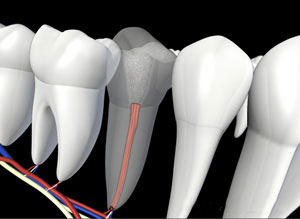
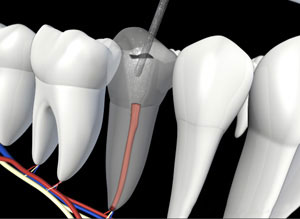
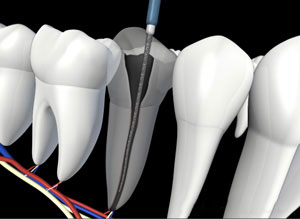
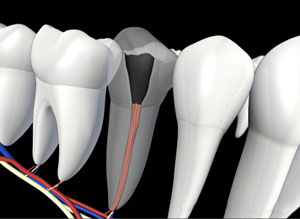
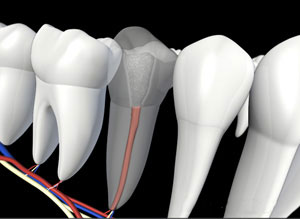
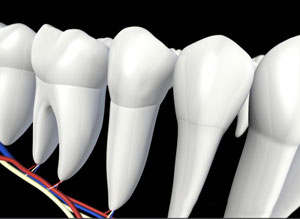
The Retreatment Process, Step by Step
Retreatment follows the same general path as a root canal, but with additional steps to address the previous work. After administering local anesthesia — and nitrous oxide for patients who prefer it — the crown or filling material is accessed, and the existing root canal filling is carefully removed. This gives the doctors direct visibility into the canals to identify exactly where the original treatment left issues unresolved.
The canals are then reshaped, recleaned with ultrasonic irrigation to disinfect thoroughly, and resealed with fresh biocompatible material. If a post was placed during the original restoration, additional planning may be needed to safely remove it without compromising the tooth structure — something the 3D CBCT scan helps account for before the procedure begins.
Once retreatment is complete, a temporary filling is placed and you’ll return to your general dentist for a new permanent crown. The step-by-step illustration above shows this process from initial inflamed tissue through to the fully healed tooth.
Retreatment vs. Extraction: Why Saving the Tooth Matters
When a root canal has failed, the choice is typically between retreatment and extraction. Retreatment should almost always be considered first. Extraction removes the problem but creates a new one — the gap needs to be filled with an implant or bridge to prevent neighboring teeth from shifting and bone from resorbing, a process that takes months and costs more than retreatment in most cases.
Keeping your natural tooth root intact preserves jaw bone density and maintains the structural relationships between your surrounding teeth. A successfully retreated tooth with a new crown can last just as long as a tooth that was treated correctly the first time. The goal at West Atlanta Endodontics is always to save the tooth when it’s clinically possible — extraction is only recommended when the tooth is not restorable or the long-term prognosis is poor regardless of retreatment.
When Should You Consider Retreatment?
The most obvious sign is pain or pressure returning in a tooth that was previously treated. But symptoms aren’t always present. Other indicators include swelling near the tooth, a pimple-like bump on the gum, tooth discoloration, or a new shadow visible on X-ray at the root tip. In some cases, your general dentist spots a failing root canal on a routine X-ray before you feel anything at all — which is actually the best time to address it, since early retreatment is more straightforward than treating an established reinfection.
If you’ve been referred for retreatment, or if a previously treated tooth is causing new symptoms, a consultation at West Atlanta Endodontics will clarify whether retreatment is the right path — or whether an apicoectomy would be more appropriate for your specific situation.
Endodontic Retreatment in Marietta, GA: Frequently Asked Questions
How is retreatment different from a root canal?
A root canal is performed on a tooth that has never been treated before. Retreatment revisits a tooth where a root canal has already been done but has failed to fully resolve. The process involves removing the existing filling material, identifying and addressing what went wrong — missed canals, incomplete sealing, new decay — and resealing the tooth. Retreatment typically requires more time and planning than an initial root canal because there’s prior work to work around.
How do I know if my root canal has failed?
Common signs include returning pain or pressure in a previously treated tooth, new swelling near the tooth, a bump on the gum, tooth discoloration, or a new lesion visible on X-ray at the root tip. In some cases there are no symptoms at all and the failure is caught on a routine checkup X-ray. If you have any concerns about a previously treated tooth, a consultation and cone beam CT scan will give a clear picture of what’s happening at the root level.
Is retreatment always an option?
Not always. If a post has been placed inside the root canal, removing it adds complexity — but it’s often still feasible. If the tooth is fractured vertically, the prognosis for retreatment or any other treatment is poor and extraction may be the better recommendation. Dr. Norrington and Dr. Smithson will review your imaging and give you an honest assessment of whether retreatment is likely to succeed before recommending a path forward.
What happens after retreatment?
After retreatment is complete, a temporary filling is placed and you’ll return to your general dentist for a new permanent crown within a few weeks. Healing is monitored at a follow-up appointment using X-rays to confirm the infection has resolved. Most patients experience mild tenderness for a few days after the procedure, managed easily with over-the-counter pain relievers.
Endodontic Retreatment in Marietta, GA
Dr. Norrington and Dr. Smithson treat retreatment cases at their Marietta, GA endodontic practice and Cartersville location. If a previously treated tooth is causing problems — or if your general dentist has spotted a concerning X-ray — contact West Atlanta Endodontics to schedule an evaluation. Referring dentists can submit cases through the referral form.